


It’s the January silly season. Marco Silva wants more players, but will he/we get any? And, if we do, will they be any good? Well, I can’t assure you (or Marco) that we will land new talent this month (although I hope so), but I can tell you that – based on the numbers – the odds are that if we do land a new player (number nine or number eight please) it’s very likely the transfer will be successful - which is not the case for most of the Premier league.
The measure of success
The rule of thumb for the Premier League is that only about half of all transfers - like marriages - are successful. The odds of failure are pretty great. You’d assume that based on our history (Terence Kongolo anyone?) we’d be worse than most. But actually, it’s the opposite.
Ian Graham, the former head of analytics and director of research for Liverpool (one of the main purveyors of Moneyball in the Premier League), analyzed all transfers of players to the Premier League from 1992 to January 2021 (greater than £10m) for his book How to Win The Premier League.
He came up with a simple measure of success: what percentage of players started more than half of the games in a two-year period? He found that – on average – new players acquired via transfer only did so 54% of the time, meaning that 46% of players transferred did not start more than half of the games.
Graham’s analysis roughly mirrors other analyses including Paul Tomkins’s more complex approach (a weighted mixture of transfer fee paid, inflation, transfer fee received, and number of games started). Tomkins found that 60% of transfers failed. Graham references Tomkin’s analysis in his book.
High performance
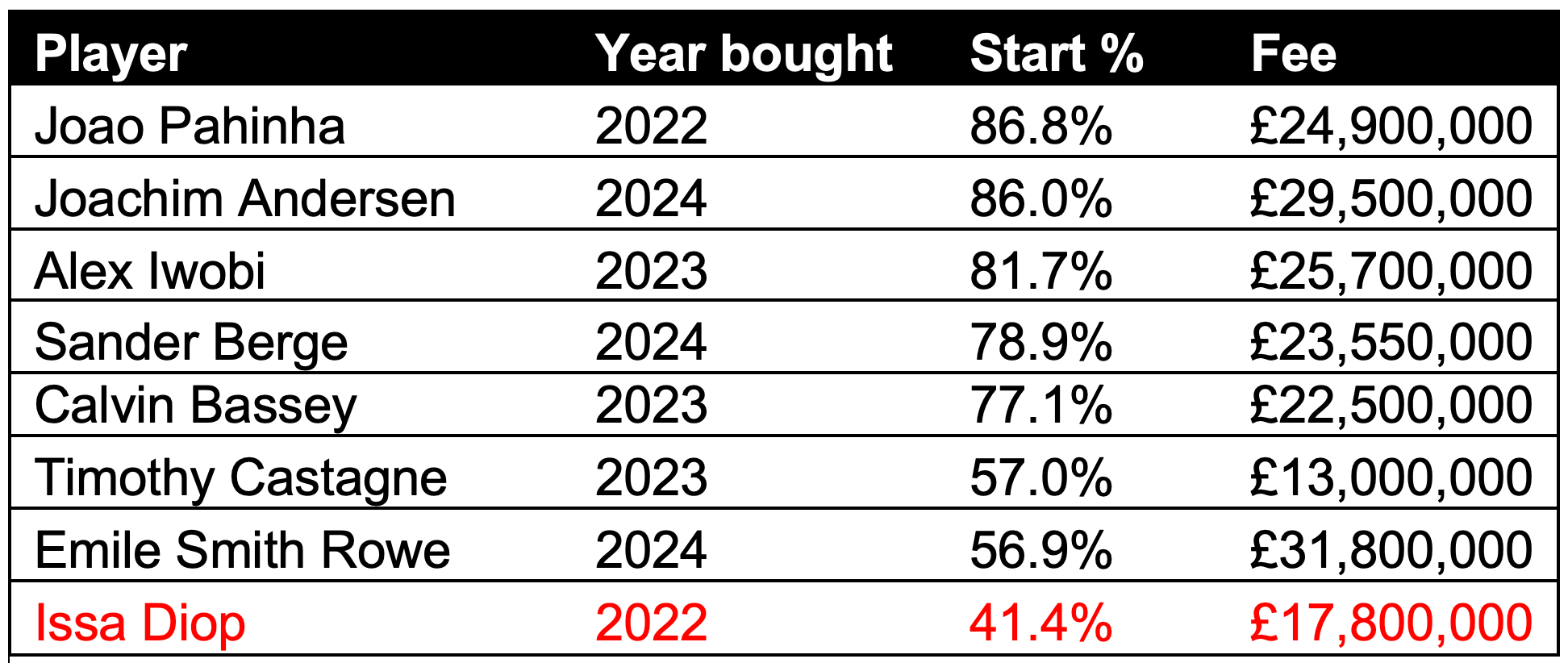
Based on Graham’s approach, I analyzed Fulham transfers worth more than £10m from 2022 to 2024 (our most recent period of sustained Premier League football). I considered starts through the Liverpool game this year (2026) for these transfers. I found that 88% of Fulham’s transfers during this period started more than half of the games played. The one ‘failure’? Issa Diop, who cost £17.8m and has started a little more than 40% of the games played. Even a back-up player like Timothy Castagne has started more than half the time for the team (57%) - though Kenny Tete’s injuries have inflated that figure.
I also looked at the financial value of Fulham’s transfers for this period to validate this strong result. Graham also discusses the issue of “impairments” in his book. Impairments refer to the negative value of players on a team’s books. One study, cited by Graham, found that Premier League clubs recorded more than a quarter a billion pounds of impairments between 2020 and 2022. In 2021/22, Chelsea had £77 million in impairments.
Impairments happen when a team buys a player and the player’s market value drops below what the team paid for that player. It’s an accounting term and refers to the amortized value of the transfer fee versus the player’s current resale value. For example, Fulham bought Emile Smith-Rowe for £31.8m on a five-year contract in 2024. Given that we are roughly 1.5 years into ESR’s contract, this means his current book value for the club (in terms of his transfer fee) is £22.26m.
ESR’s value on Transfermarkt is currently £22m, which would mean (assuming Transfermarkt represents the actual market value) that Fulham would have an impairment of £260,000 for Smith Rowe. It turns out that – for the players analyzed above (those with transfer fees above £10m) that this is Fulham’s only impairment, and it’s small. Fulham appears to be – in terms of transfers – successful on this basis as well. The players the club has bought are largely in the black (according to their book and market value).
Darker days
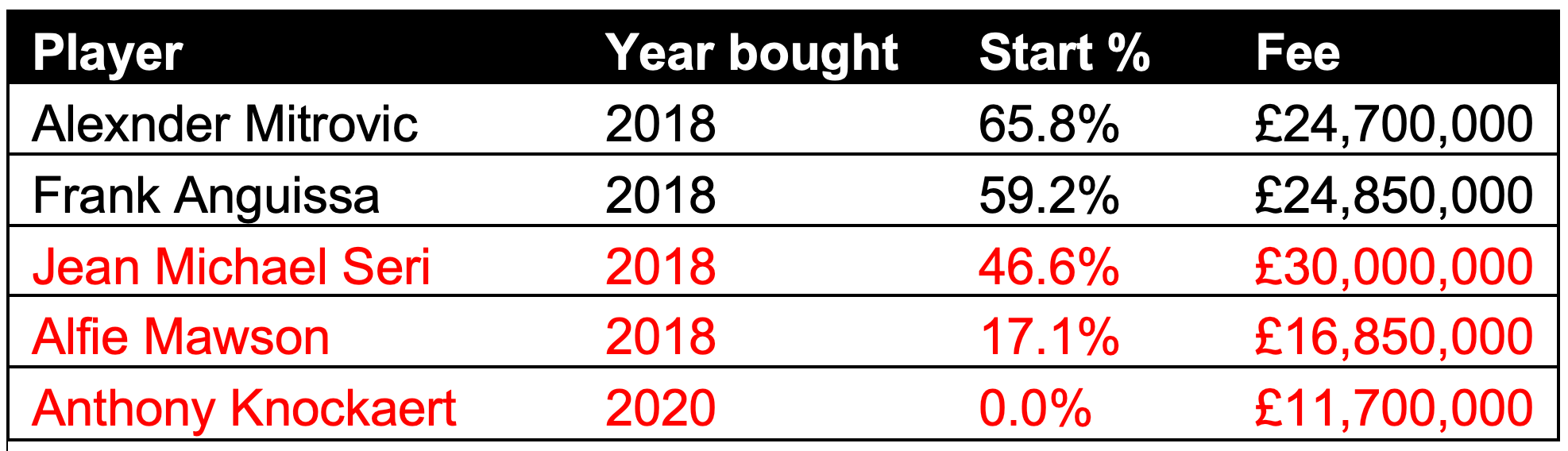
So, what accounts for Fulham’s success in transfers? To answer this question, for a point of comparison, I combined the last two seasons Fulham was in the Premier League (2018/19 and 2020/21) under the Khan’s ownership (and Tony Khan’s and Alistair Mackintosh’s leadership of transfers) and looked at starts for players with transfer fees of more than £10m. The reasoning was that 2018/19 players on the squad were largely still in place for the 2020/21 season and that the 2020 season by itself was a disaster in terms of this analysis – as only Anthony Knockaert qualifies. For these combined seasons, Fulham underperformed the league average for starts for transfers with an average of 40% of transferred players getting starts over these two seasons.
The difference maker
The contrast is significant. On this basis, Fulham went from having only 40% of its transfers start to 88%. While there are many possible reasons for this change, to me the biggest difference between these two sets of data was the arrival of Marco Silva. It is possible that he directly impacted transfers as part of the recruitment team and also as manager of the transferred players. My belief is that the difference is largely due to the latter.
Silva’s ability to develop players (old and young) into Premier League quality starters is remarkable. A good example of this is a player who falls just below the £10m transfer line: Sasa Lukic (the transfer fee was £9.8m). Lukic’s transition to the Premier League from Serie A began slow and he only started four games in his first season but, as we know, has become a regular starter for us since thanks in part to Silva’s help.
Silva has also helped to rehabilitate players like Raul Jimenez and Willian, plus many others. While Marco isn’t perfect in this regard, as evidenced by the Kevin Mbabu disaster, his record is truly impressive. We will see if he can also work his magic on younger players like the biggest transfer for the 2025/26 season, Kevin, who has started a little more than 30% of possible games so far. Given ESR’s recent progress in becoming a true PL starter, I am optimistic that Marco can do this with Kevin as well.
Of course, if Marco goes this summer, what will become of Fulham’s transfer success? It may well disappear – unless the club can replace him with another manager capable of turning transferred players into regular PL starters.

Love the article! I’ve read how to win the premier league and enjoyed it. I agree with everything you said, but a confounding factor is that Fulham carries less players than the bigger clubs, so they sometimes have to start their signing regardless do to limited options.
Really interesting insight