


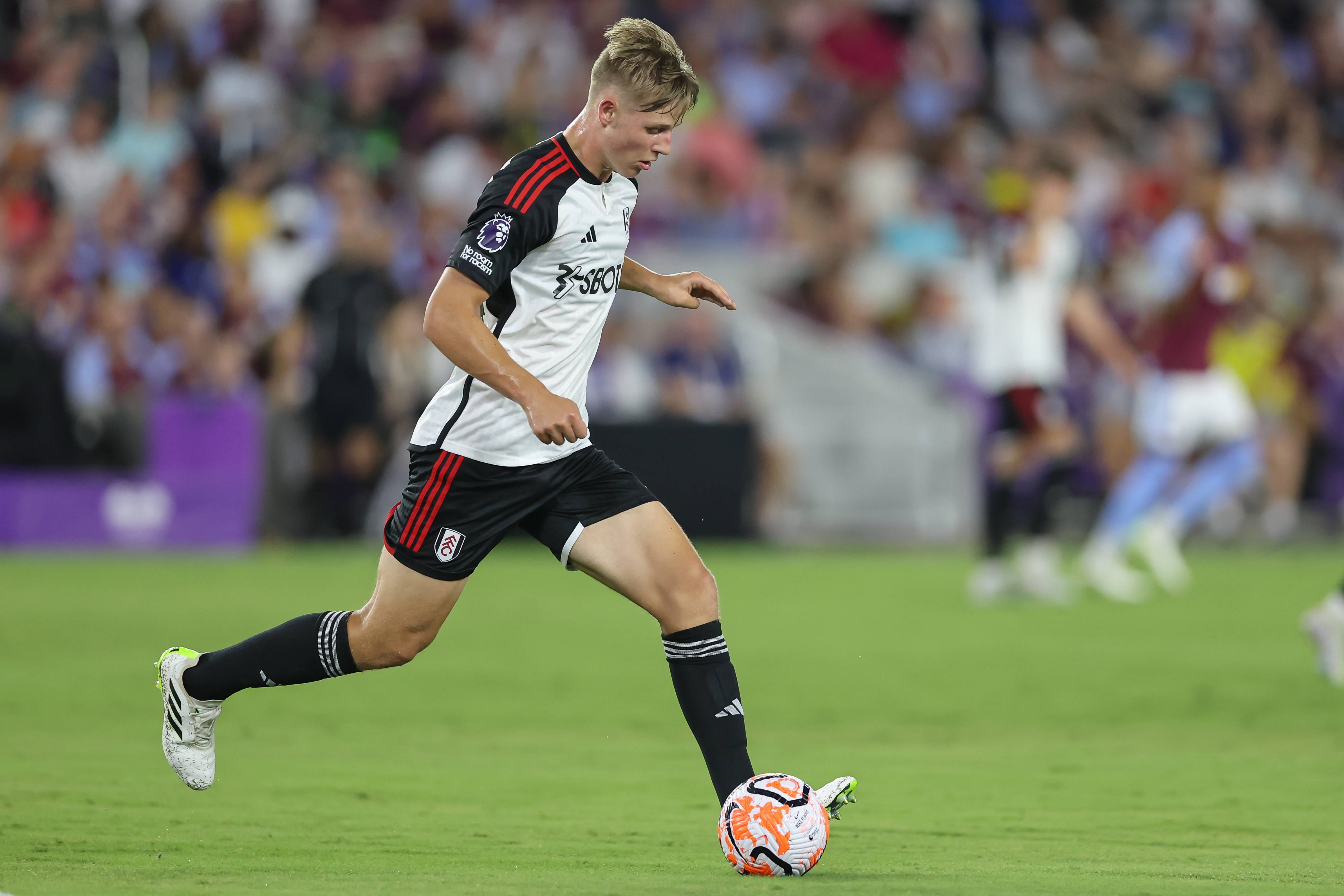
A few months ago, the conversation around Luc De Fougerolles centred on potential. Today, it centres on opportunity.
The 20 year old arrived at the World Cup as one of Canada’s youngest squad members and with only limited senior football experience. Yet after two group-stage matches, he has looked increasingly comfortable on one of football’s biggest stages.
While it would be reckless to draw definitive conclusions from a sample size of just two games, it could become increasingly difficult to argue that de Fougerolles should begin the 2026/27 season outside Fulham’s senior matchday plans.
The question is no longer whether he has potential. The question is whether he has already done enough to warrant a place on Fulham’s bench.
World Cup so far
Canada’s opening match against Bosnia and Herzegovina provided the clearest glimpse yet into what LdF could become.
Making his World Cup debut, he played the full 90 minutes and recorded eight clearances, six headed clearances and won 11 duels. For a young centre-back facing a proven Bundesliga striker in Demirović and a physical partner in Lukić.
Those numbers were impressive not simply because of their volume, but because of what they revealed about his game. He was willing to engage physically, comfortable defending his penalty area and showed no signs of being overwhelmed by the occasion or experience/pedigree of opposition.
Canada’s subsequent 6-0 victory over Qatar offered far fewer opportunities for defensive heroics, but showcased another side of his game. While Canada by no means dominated possession (they actually had less of the ball). LdF operated a mix of a ‘Centre-back box crasher’ alongside playing key roles in the high line build up that Canada employed in a ‘quarterback’ role that he wouldn’t often get the time to exhibit in the Premier League.
While Luc was replaced on 71 minutes in both matches, together, the two performances painted the picture of a modern centre-back: comfortable defending his box while also possessing the composure and technical ability required in possession. With tinges of leadership on display, his future is bright.
The Andersen comparison
Any discussion about de Fougerolles’s future at Fulham inevitably leads to comparisons with the players currently ahead of him.
The most obvious benchmark is Joachim Andersen. The Danish international would be described as Fulham’s defensive leader in the RCB spot. While he would formally have been seen as one of Premier League’s most reliable centre-backs, his stock may have fallen a little following a disappointing and quite frankly unprofessional decision towards the end of the season.
During the 2025-26 Premier League season, Andersen accumulated 257 clearances across 33 appearances, won 131 of his 208 duels and 74 of his 103 aerial contests while recording 36 interceptions.
Clearly, de Fougerolles is nowhere near matching that volume of production. Andersen has nearly 3,000 Premier League minutes behind those numbers, while de Fougerolles has only two World Cup appearances to analyse. Any direct comparison must be treated with caution.
However, what is striking is how similar some of the underlying traits appear.
Like Andersen, de Fougerolles looks comfortable defending deep. Like Andersen, he shows a willingness to attack aerial balls rather than merely react to them. Like Andersen, he appears calm in possession and willing to progress the ball rather than simply clear his lines.
Andersen’s greatest strength is arguably his ability to combine traditional defending with modern ball-playing qualities, and some of those same attributes are increasingly visible in de Fougerolles’s game.
Why the sample size doesn’t matter as much as you think
Sceptics will rightly point out that two World Cup matches do not guarantee Premier League readiness.
They would be correct. Hello Ragnar Sigurðsson.
The purpose of a bench role is not to identify players who are already Premier League starters. It is to identify players who are capable of contributing when called upon.
What de Fougerolles has demonstrated is that he can handle pressure, adapt to high-level opposition and maintain his composure in major moments. Those qualities are often more difficult to teach than technical ability.
At 20 years old, he already looks capable of stepping into senior matches without appearing overawed. That alone is significant.
The strongest argument for inclusion
Perhaps the strongest argument for de Fougerolles’ inclusion is not statistical at all.
Fulham have spent years searching for a sustainable pathway between their academy and first team. When a young player performs well at international level, against senior professionals, in the pressure cooker of a World Cup, there comes a point where continued exclusion becomes harder to justify than inclusion.
I am not suggesting De Fougerolles should replace Andersen yet. But a place on the bench is a different conversation entirely providing we find a manager who trusts in young talent.
If a 20-year-old centre-back can start World Cup matches for Canada, win 11 duels on his tournament debut and display the composure of a far more experienced player, then it becomes reasonable to ask why he shouldn’t be trusted as Fulham’s fourth or fifth defensive option - at the very least.
Verdict
The World Cup has not proven that Luc De Fougerolles is ready to become a Premier League starter. What it may have proven is that he has outgrown the category of “academy prospect”.
Football careers often change because of moments exactly like these - two games into the World Cup, De Fougerolles has not forced his way into Fulham’s starting XI. He may, however, have played his way onto the bench.
One thing is certain, if we don’t give him his chance, and a pathway - somebody else will. The biggest remaining question is whether our new incoming manager is willing to open that pathway up.

Let’s hope he doesn’t go the way of Jay Stansfield!
If the Alistar Johnson rumors are true, it would make perfect sense to purchase him and have Luc and Alistar play together on the backline for club and country.