



After another season of Premier League consolidation rather than progression, Fulham find themselves at a crossroads.
Marco Silva built a stable and competitive top-flight side, but the next challenge is turning that stability into genuine advancement.
That responsibility now falls to Alvaro Arbeloa.
The announcement late last night, finally confirming that the ex-Real Madrid man will be in the Fulham dugout next season hasn’t come a moment too soon - and he already has a stacked inbox.
While Fulham’s final league position suggests a relatively comfortable campaign, a closer examination of the underlying numbers reveals several tactical shortcomings that prevented the club from mounting a sustained challenge for the European places. This is not an assessment of individual players, but of the systems and structures that shaped Fulham’s season.
The encouraging reality is that none of these issues appear insurmountable. If Fulham are to take the next step towards Europe 2026/27, however, there are five key tactical problems that must be addressed.
1. Creating more high-quality chances
The clearest issue from Fulham’s season was their inability to consistently generate dangerous scoring opportunities.
While the Whites’ goal tally broadly aligned with their expected goals output, the underlying concern was the sheer lack of high-value chances being created. Fulham produced fewer big chances than any other side in the division, highlighting an attack that too often relied on moments of individual quality rather than repeatable attacking patterns.
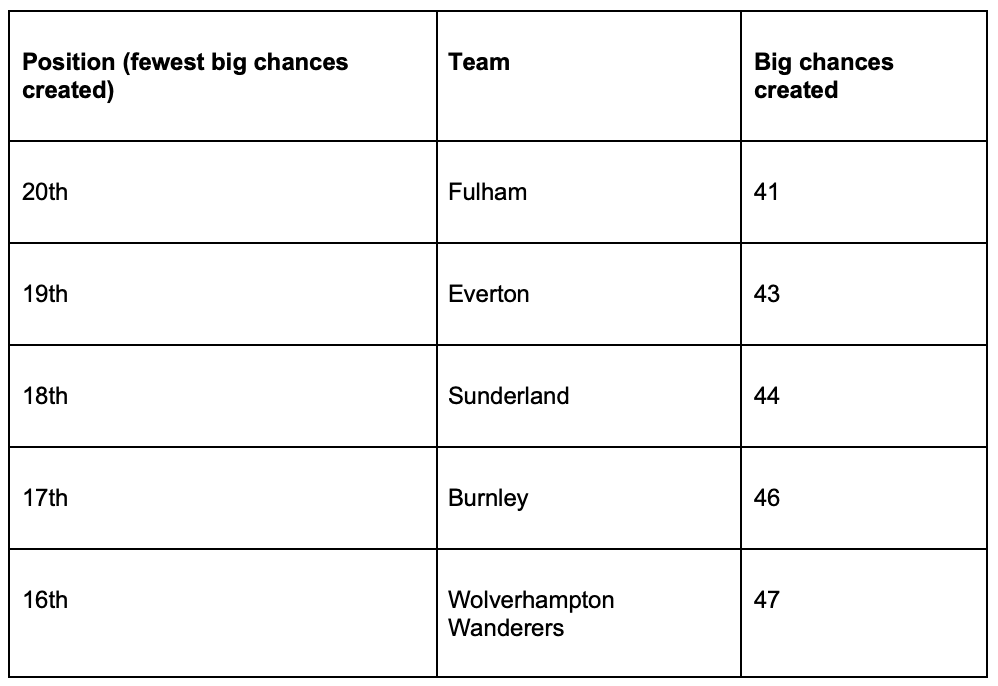
Fulham frequently progressed the ball into advanced areas but struggled to turn promising possession into clear-cut opportunities. Too many attacks ended with speculative efforts or hopeful deliveries rather than genuine chances.
If Fulham are serious about challenging for Europe, increasing the volume of high-quality opportunities must be the primary objective. A new striker may help, but chance creation is ultimately a collective tactical issue rather than an individual one.
2. Becoming less predictable in possession
One reason behind Fulham’s lack of chance creation was the predictability of their attacking structure. Drilled to diligent design, but lacking fluidity and unpredictability.
The Whites were actually one of the Premier League’s more effective crossing teams, completing over 25% of their crosses and ranking seventh in the division for crossing accuracy. The problem was not getting the ball into dangerous areas. The problem was that opponents often knew where Fulham’s attacks were coming from.
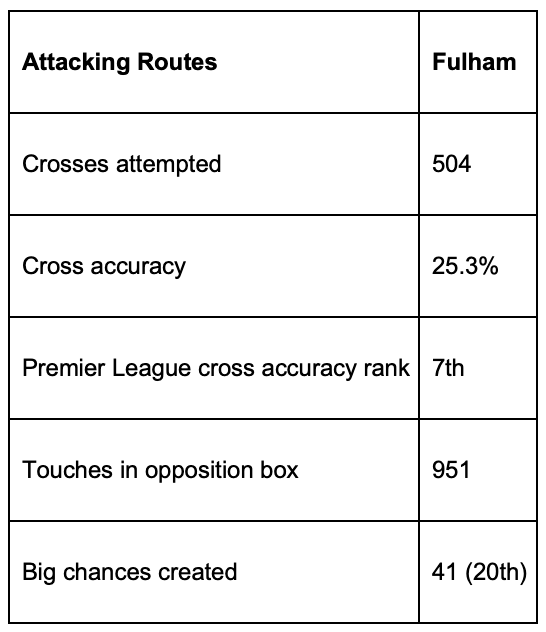
Despite delivering quality crosses and recording a healthy number of touches in the opposition penalty area, Fulham still created the fewest big chances in the league.
The data suggests a side heavily reliant on wide attacks, with too few opportunities created through central combinations, through balls or late midfield runs. The Premier League’s strongest attacking teams can hurt opponents in multiple ways. Fulham often lacked that variation.
Adding greater central creativity and more unpredictable movement between the lines should be a major focus under Arbeloa.
3. Developing a more effective away identity
Fulham’s home form remained competitive throughout the season, but their performances away from Craven Cottage often lacked the same consistency.
Too many away matches followed a similar pattern. Fulham struggled to establish territorial control, found it harder to sustain pressure and frequently looked less comfortable when games became open and transitional.
This points to a tactical challenge rather than a purely psychological one. The team often appeared caught between two approaches: pressing aggressively or retreating into a compact block. The result was that neither strategy consistently functioned at its best.
Developing a clearer away-game identity could significantly improve Fulham’s points return on the road. Whether through a more structured counter-attacking framework or a midfield better equipped to manage transitions, greater clarity is needed when Fulham leave home.
4. Improving defensive transitions
Fulham’s overall defensive record was respectable, but there were recurring problems when possession was lost.
When attacks broke down, opponents were often able to exploit the spaces left behind, particularly through central areas. With full-backs pushing forward and midfielders committed to attacks, Fulham occasionally lacked the structure needed to slow counter-attacks before they became dangerous.
This is an increasingly important area of the modern game. The best Premier League sides are not only effective with the ball, they are also exceptional at reacting immediately after losing it.
Improving defensive transitions would likely have a disproportionate impact on results. Turning a handful of counter-attacking opportunities into harmless possessions can be the difference between a draw and a win, or a defeat and a point.
5. Extracting more value from set pieces
Set pieces have become one of the most important battlegrounds in modern football, yet Fulham failed to maximise their potential in this area.
With several strong aerial players and a steady stream of corners and free-kicks throughout the season, there was a clear opportunity to generate additional goals from dead-ball situations. Compared with some of the league’s most efficient set-piece teams, Fulham’s returns remained relatively modest.
This is also one of the most correctable issues on the list.
Improved routines, better movement, more effective screening and stronger second-ball organisation could all deliver marginal gains. Across a 38-game season, those marginal gains can be worth several points in the table.
For a club looking to bridge the gap to the European places, few areas offer a more immediate opportunity for improvement.
Conclusion
Fulham’s 2025/26 campaign was not a failure, but it did expose the difference between being a comfortable Premier League side and becoming a genuine contender for European qualification.
The most pressing issue remains chance creation. Fulham simply did not produce enough high-quality opportunities, and their attacking play often became predictable when opponents neutralised wide areas. Alongside improvements in away performances, defensive transitions and set-piece efficiency, addressing those weaknesses could significantly narrow the gap to the top eight.
Importantly, none of these problems require a complete rebuild. Silva’s tenure left Fulham with a strong foundation and a competitive squad. The challenge for Arbeloa is not to start again, but to refine what already exists.
If he can solve these five tactical problems, Fulham may finally be ready to move from consolidation to genuine progression.

Great piece , am delighted with the change in manager
Football became too predictable under Marco , without too much excitement in the end .
A change in viewing for me was desired , may fall flat on its face , but I think your analysis shows we were on a slippery slope anyway
Looking forward to next season , which will be my 55th 😊
Talent management is going to be the biggest issue. It seems like Fulham brought in high upside transfers and then Marco wouldn’t play them.