



Fulham are closing in on some signings (and almost 30 days before the deadline)!
Hopefully, this means that the club is done with its “wait until the last minute strategy” because it does not seem to work - as I explain below.
Tony Khan explained why the club has opted to wait in his interview with Jack Kelly in June when he referenced Marco’s request, via press conferences, for Fulham to do its business faster:
Marco really wanted us to get things done, and we did get the things done, but we also were able to save millions with the trade-off of having to have a delay for the savings of millions of pounds. And again, these are millions of pounds, which is really important. I don’t just speak from the perspective of money. It’s really about the sustainability of the club and being able to keep all of these things in line with FFP.
Tony also made it clear that waiting until the last minute wasn’t necessarily his preference adding that:
(Marco) wanted to get deals done faster but that doesn’t all come down to me getting the things done when we identify the player. There’s a lot of financial levers and things that need to be pulled. Certainly, it’s a balance, but, my dad runs a tight ship on those things, and when it comes down to millions of pounds, he’s going to hold everyone accountable.
It’s unclear who has been driving the “wait until the last minute” strategy - my guess is that it is our CEO Alistair Mackintosh proving his worth to Mr. Khan - but it is clear that Tony, Shad and definitely Ali Mac believe that they saved millions with their games of brinkmanship.
So, does waiting actually pay off? To find out, I compared all Fulham transfers since we’ve been up with those, for the same time period, at Brentford, Brighton, Crystal Palace, and Everton. So, transfers for the 2022-23, 2023-24, 2024-25 and 2025-26 seasons. This is a sample of teams - outside of the big six - that were in the league when Fulham first came up, have stayed up with Fulham, are teams with similar or lower wage bills and with a variety of approaches. Oh, and I looked at transfers in the summer and January windows and did not include any loans (only transfers).
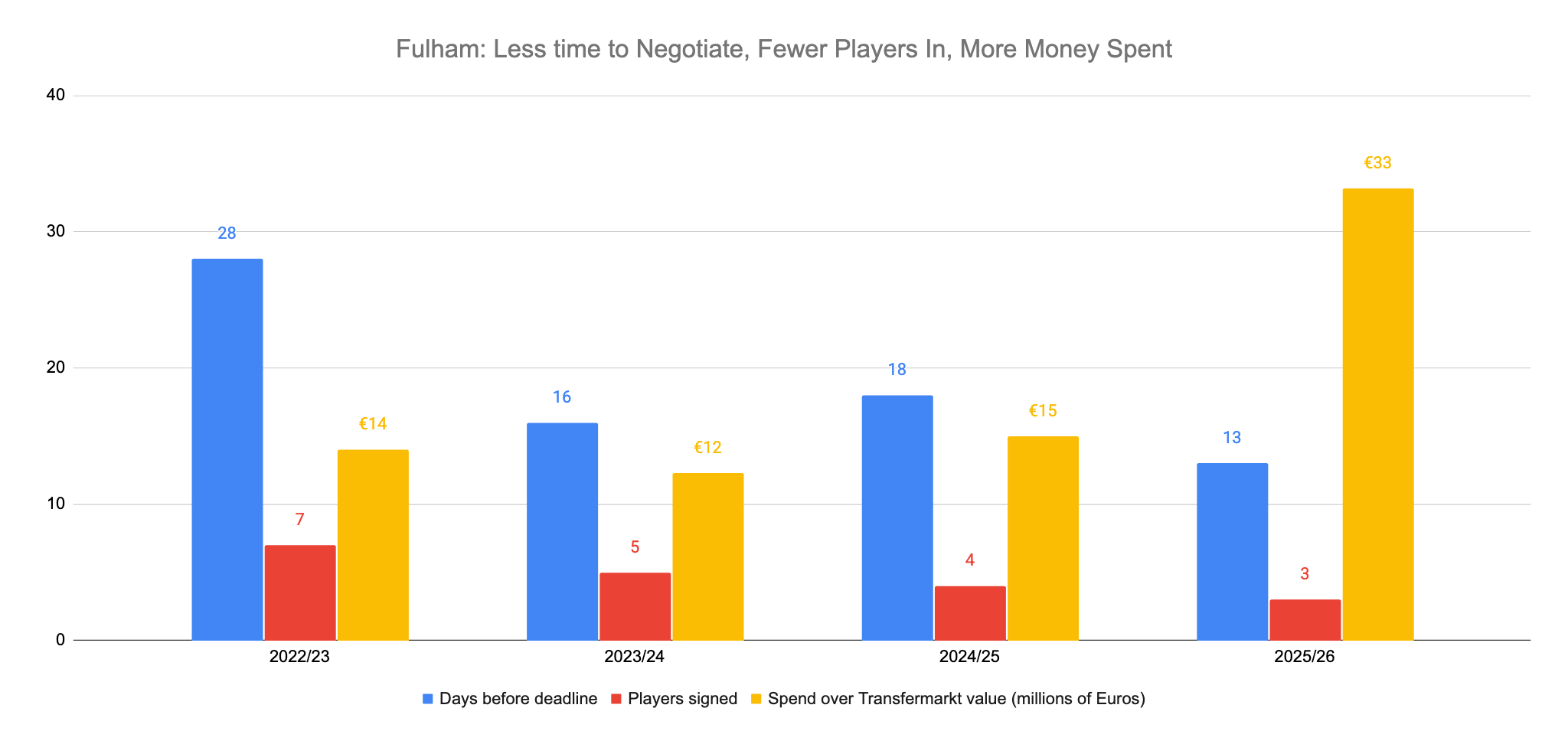
The short answer? Waiting does not really pay off. Just looking at Fulham’s business alone - it becomes clear that we - over the past four seasons - have been closing deals closer to the deadline, getting fewer players in and spending more money (compared to Transfermarkt values for those players).
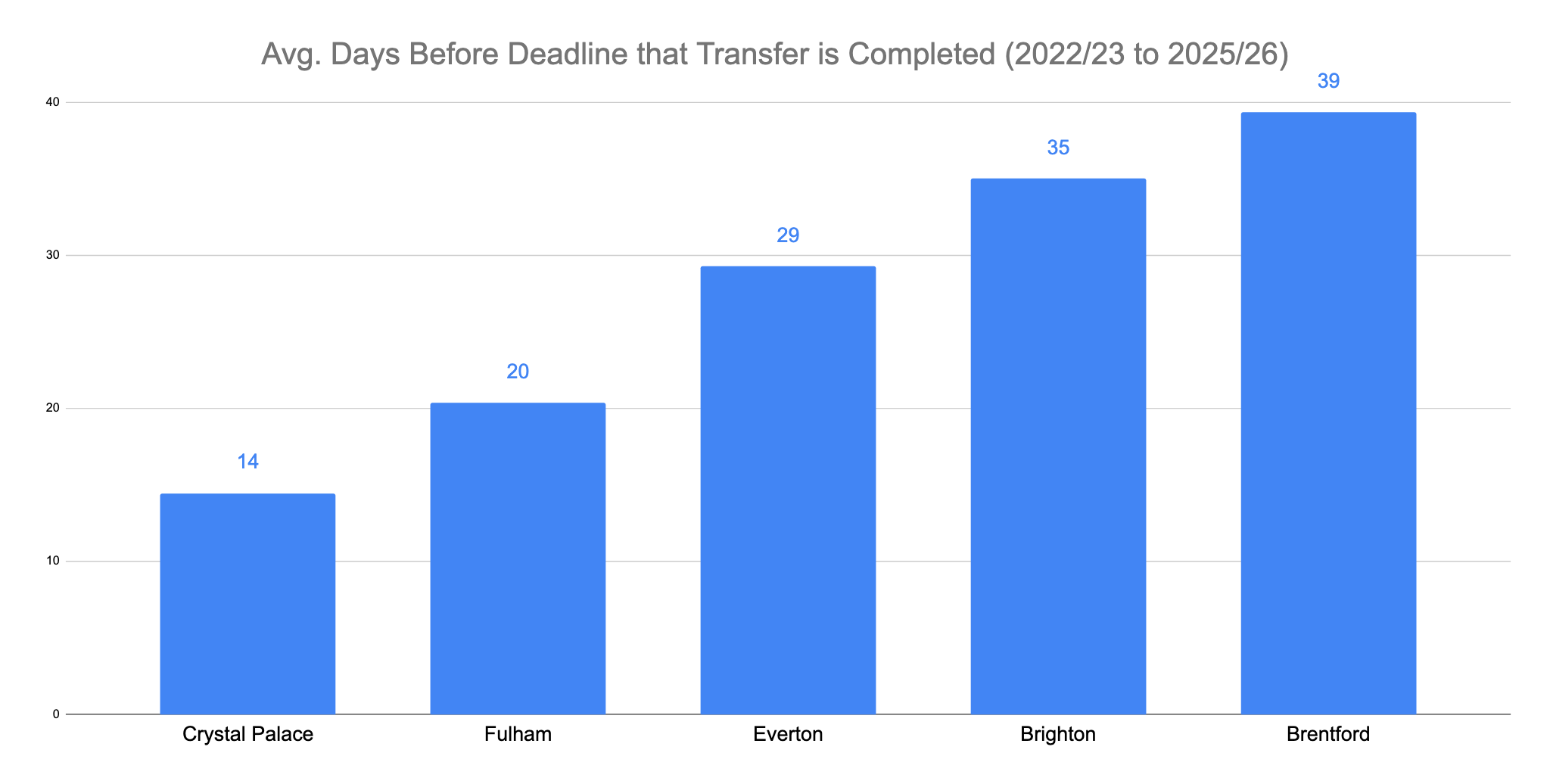
Amazingly - when you compare how long Fulham takes to complete its business, we are not the slowest club of the group studied to - on average - complete transfers. That honor belongs to Crystal Palace who - since 2022-23 - has waited 14 days on average before the window closes to do its business beating Fulham at just 20 days. So, fellow Fulham fans, things could be worse!.
But, does waiting mean saving money for the entire sample of teams? To figure this out, I compared the transfer fee that was actually paid to the listed “market value” of the player on Transfermarkt at the time of the transfer. So for example, Fulham paid €31.2m on 30 January 2026 (just days before the January deadline) for Oscar Bobb. Oscar’s Transfermarkt value at that time was €25m so this meant that Fulham “overpaid” by €6.2m. Yes, Transfermarkt is often wrong, but it is a consistent measure of market value for players and a way to compare the relative over/under pay for the group of clubs in question. Looking at the overall numbers for transfers the 2022-23, 2023-24, 2024-25 and 2025-26 seasons, it is not clear how much waiting until the last minute paid off.
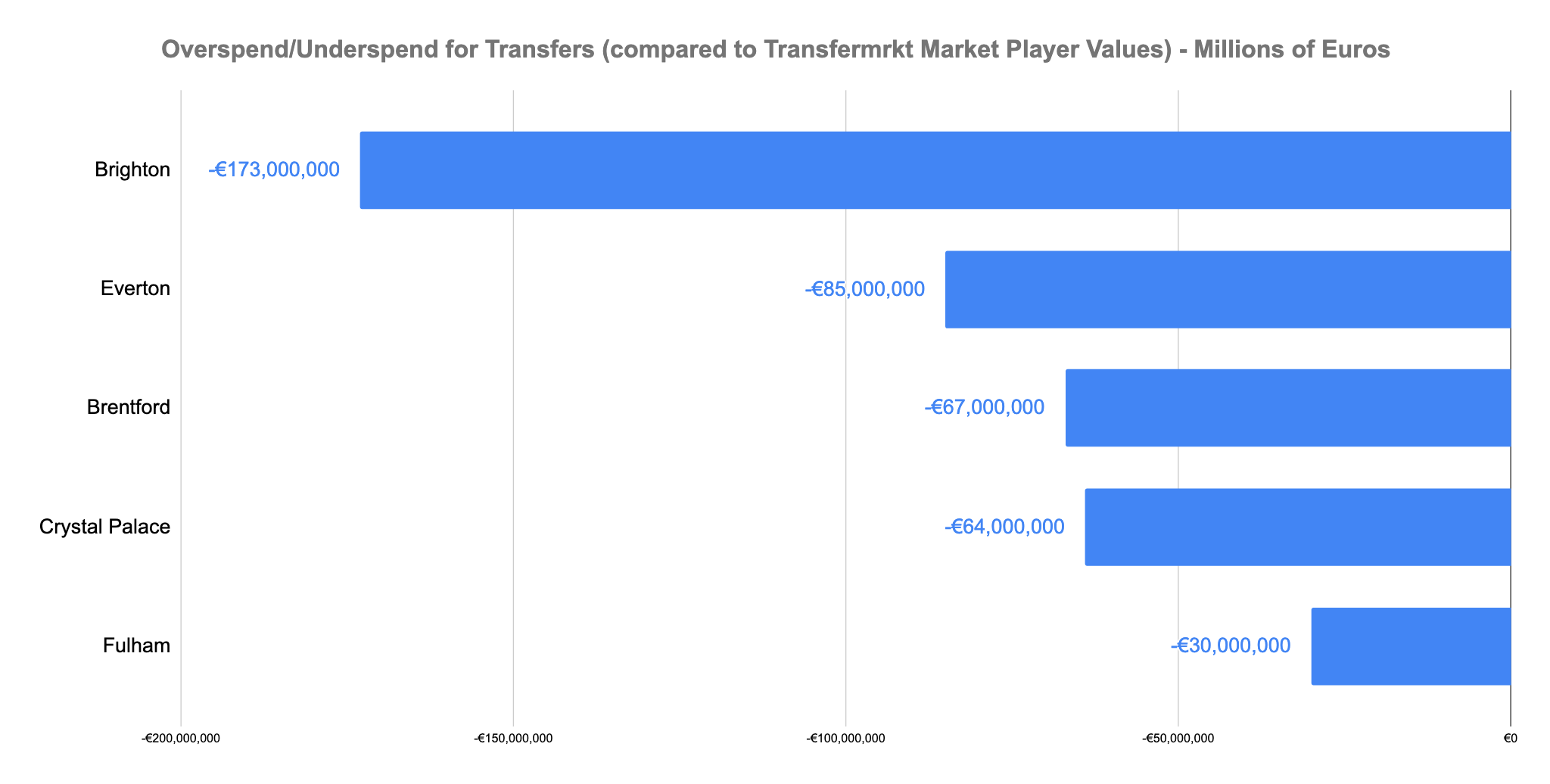
Yes, Fulham “overspent” (over Transfermarkt values) the least among this group and did do its business - on average - only 20 days before the deadline but Crystal Palace “overspent” almost as much as Brentford (the team that did its business on average, fastest) despite waiting - on average - even longer to complete transfers than Fulham. So, at first glance, it’s not clear if waiting until the last minute is correlated with getting deals because - if it was - Crystal Palace should be “overspending” even less than Fulham.
The picture gets more complicated when you look at each season. First, other teams - not just Crystal Palace and Fulham - have tried the “waiting until the last minute strategy.”
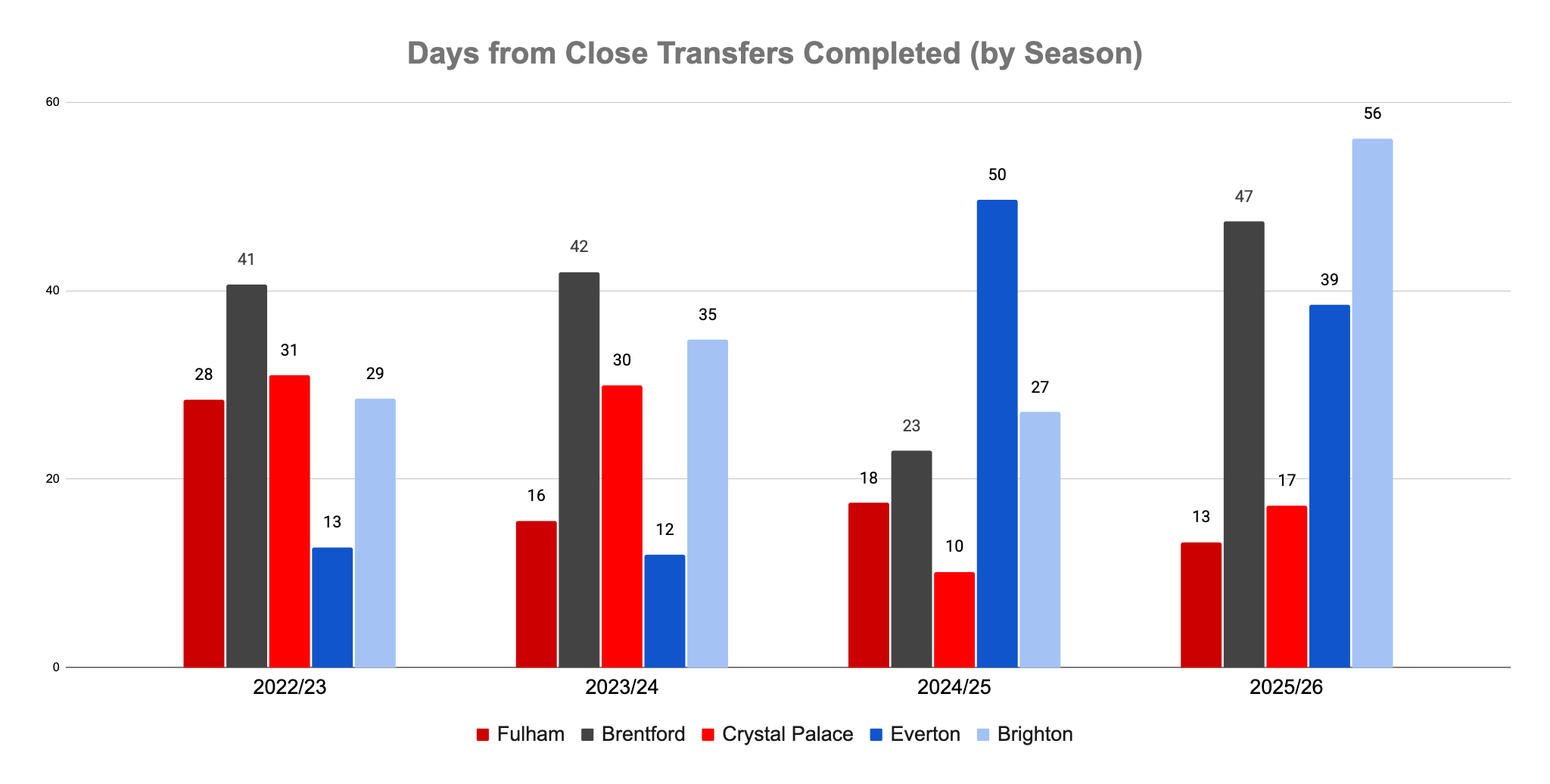
Everton, for example, waited just 13 days before the deadline to do its business on 2022-23 compared to Fulham’s 28 days that season. Even Brentford, who we think of as always getting business done fast, waited only five days longer than Fulham to get its deals done in 2024-25. And, the over/underspend numbers do not necessarily correspond to waiting.
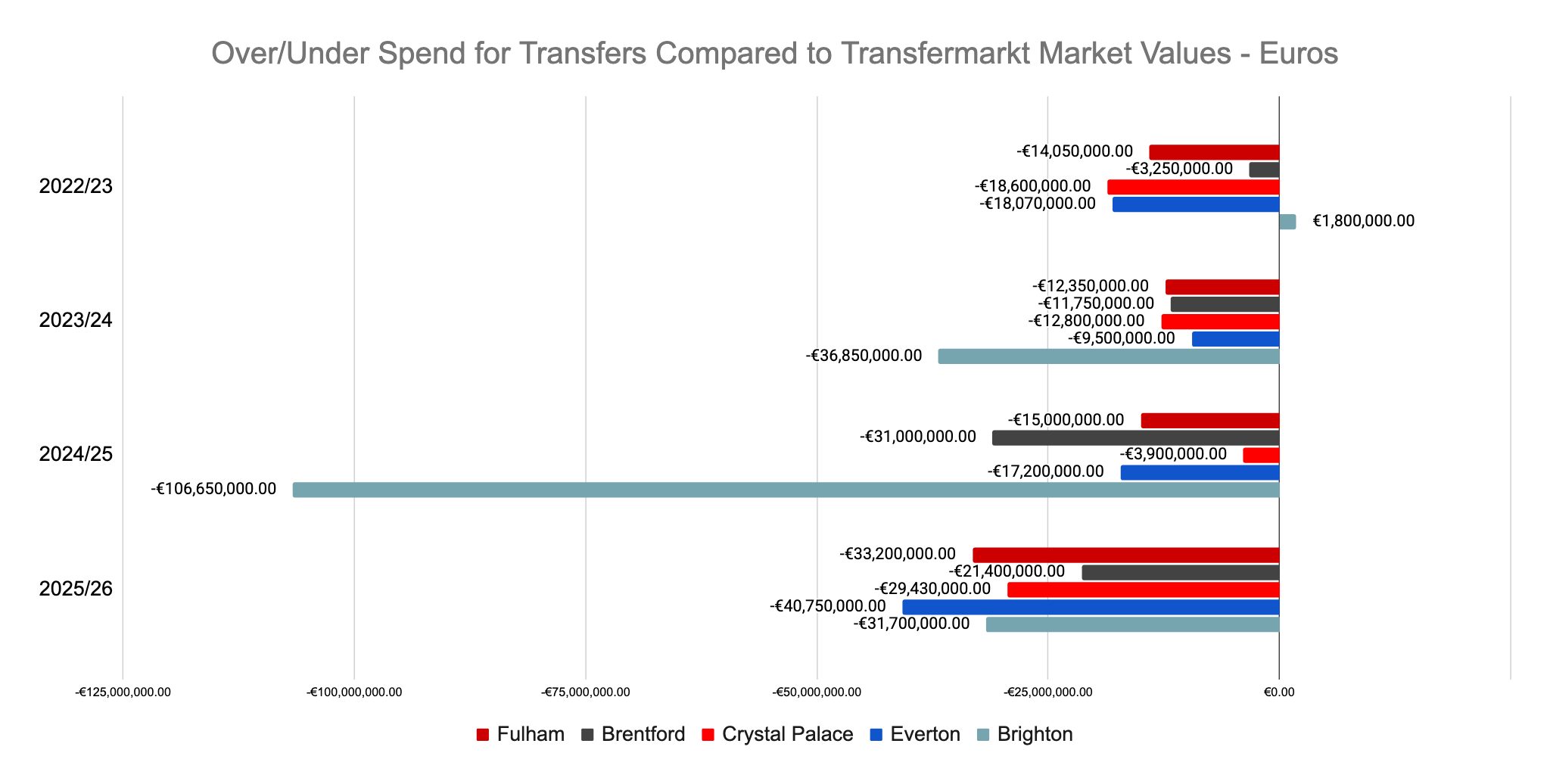
Fulham’s slowest season for getting business done was the 2025-26 season where the team - on average - signed its deals just thirteen days before the deadline but “overspent” by €33m more than any other team except for Everton (which overspent by €40m). It becomes clear that there is not a correlation between the two when you compare, by season, Fulham’s days waiting before close with the team’s “overspend.” The results vary.
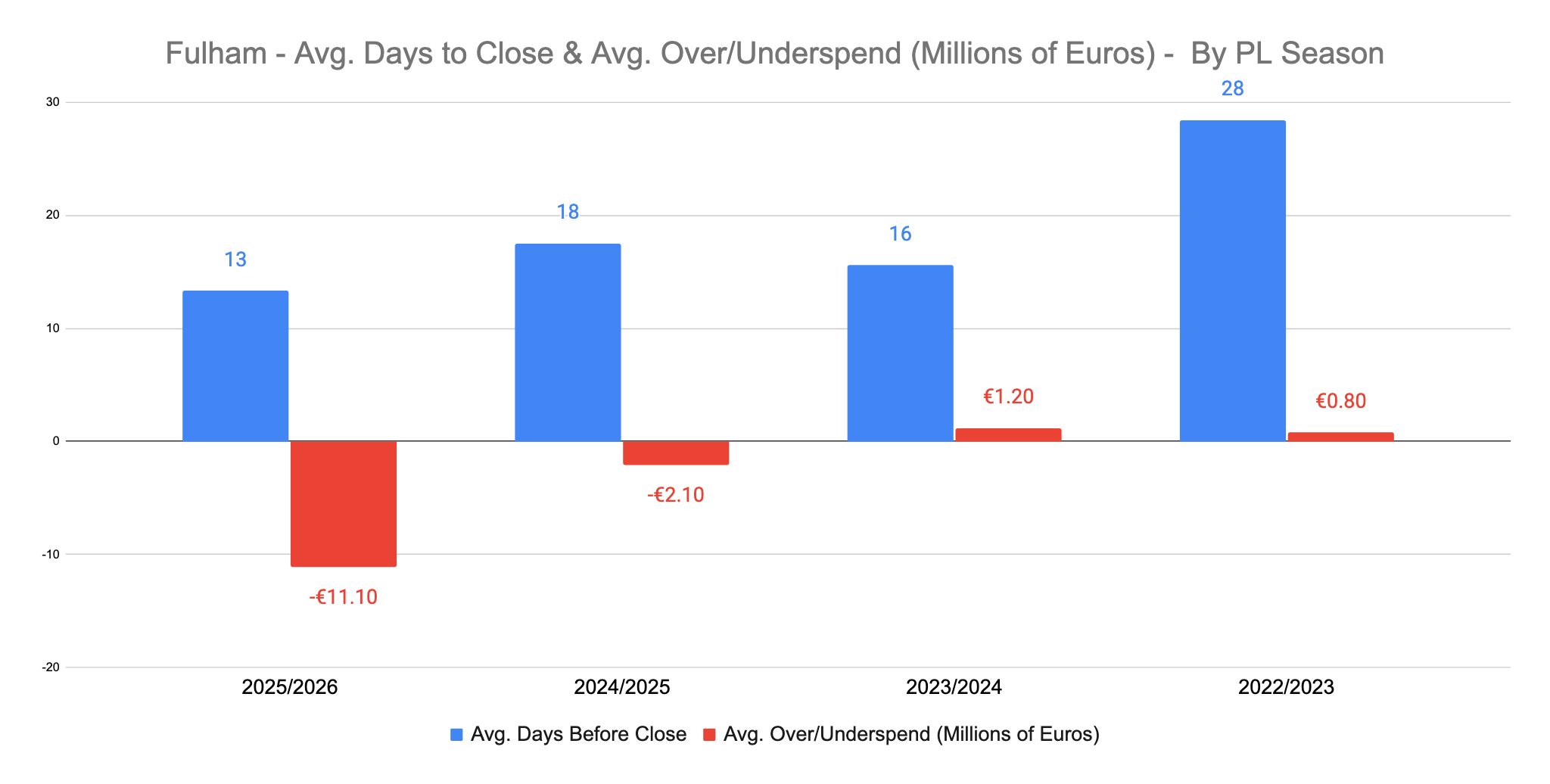
So waiting until the last minute does not necessarily mean a team is going to get the “best deal” on a given player.
Now, I do believe that Alistair Mackintosh is a dogged negotiator and do not doubt that he has driven prices down and believes he has saved the club money. But, I also think that he and Khans, by giving his view credence, are confusing correlation with causation.
It reminds me of a friend I once had in New York City who told me that her subway train was about to arrive because the train across the tracks had just done so and, she had noticed, that her train usually arrived after the one going the other way had just come into the station. I did not doubt that this happened once or twice or even three times but very much doubted that - given the complexity of the NYC subway system - that her rule was a predication of future events.
Anyway, it is clear that there is more to getting the best deal than simply waiting until the last minute and going back, again and again, to demand a lower price.
This is because the “best deal” really means getting a player who will help the club win and that the club can sell later for more money to another club. So, the math for the “best deal” should include the price the team paid and the price the team got later on for selling their players. And, it should factor in the players the team signed and was not able to sign because they waited too long or negotiated too aggressively.
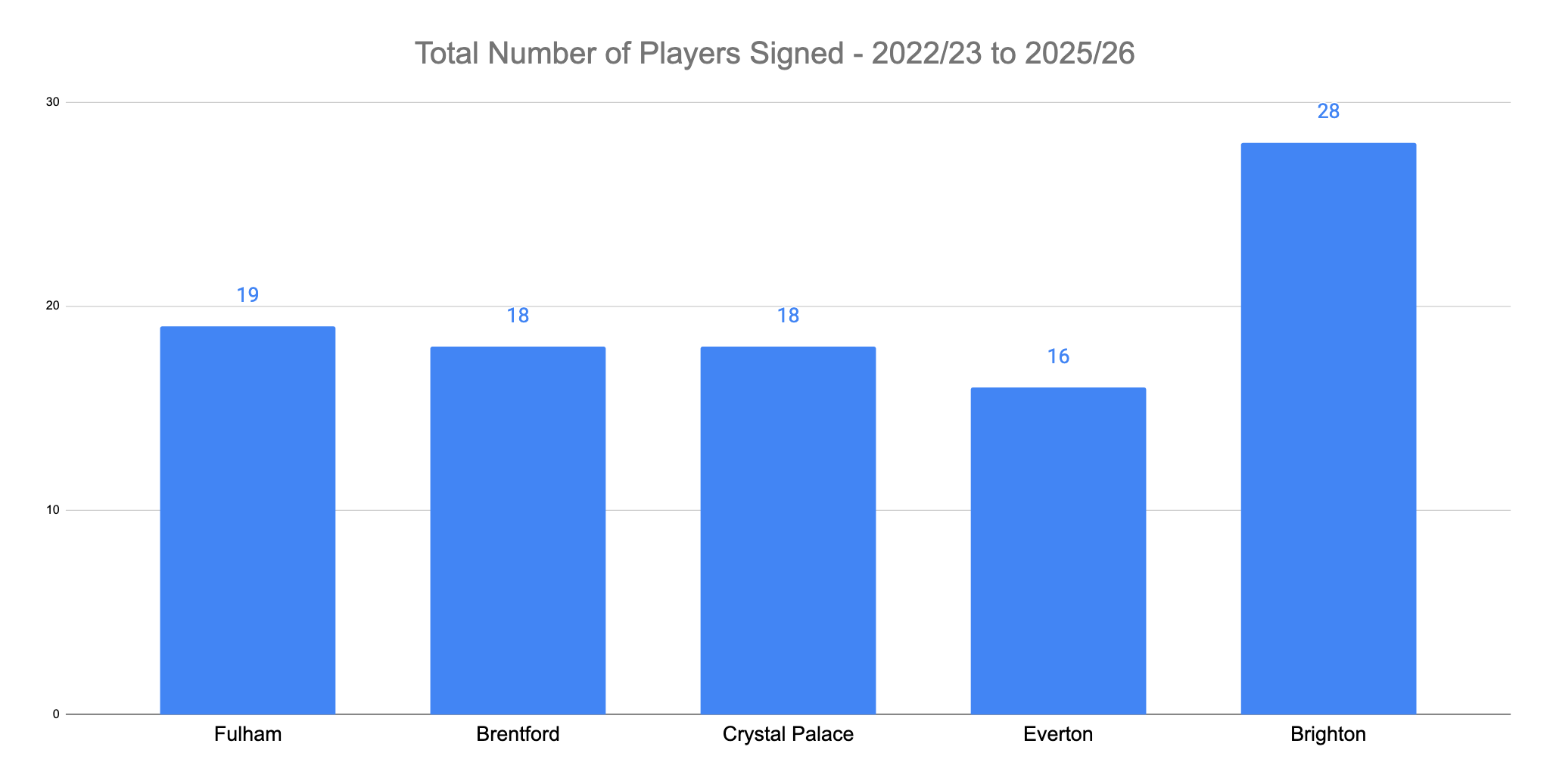
Fulham has, it turns out, been able to - overall - roughly sign the same number of players as every other team in this group, except for Brighton.
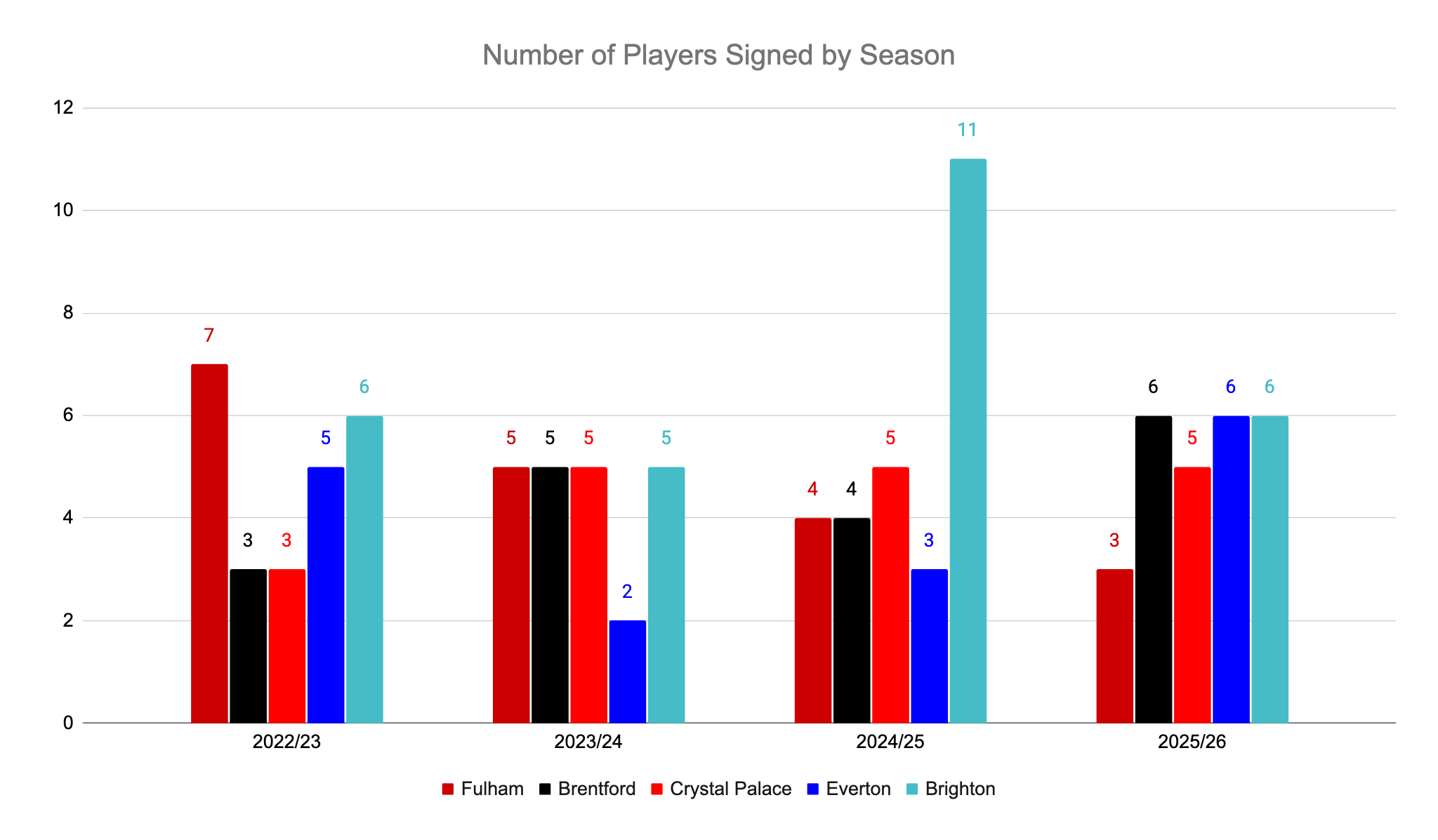
However, unlike other teams in the sample, Fulham have been signing fewer players each season.
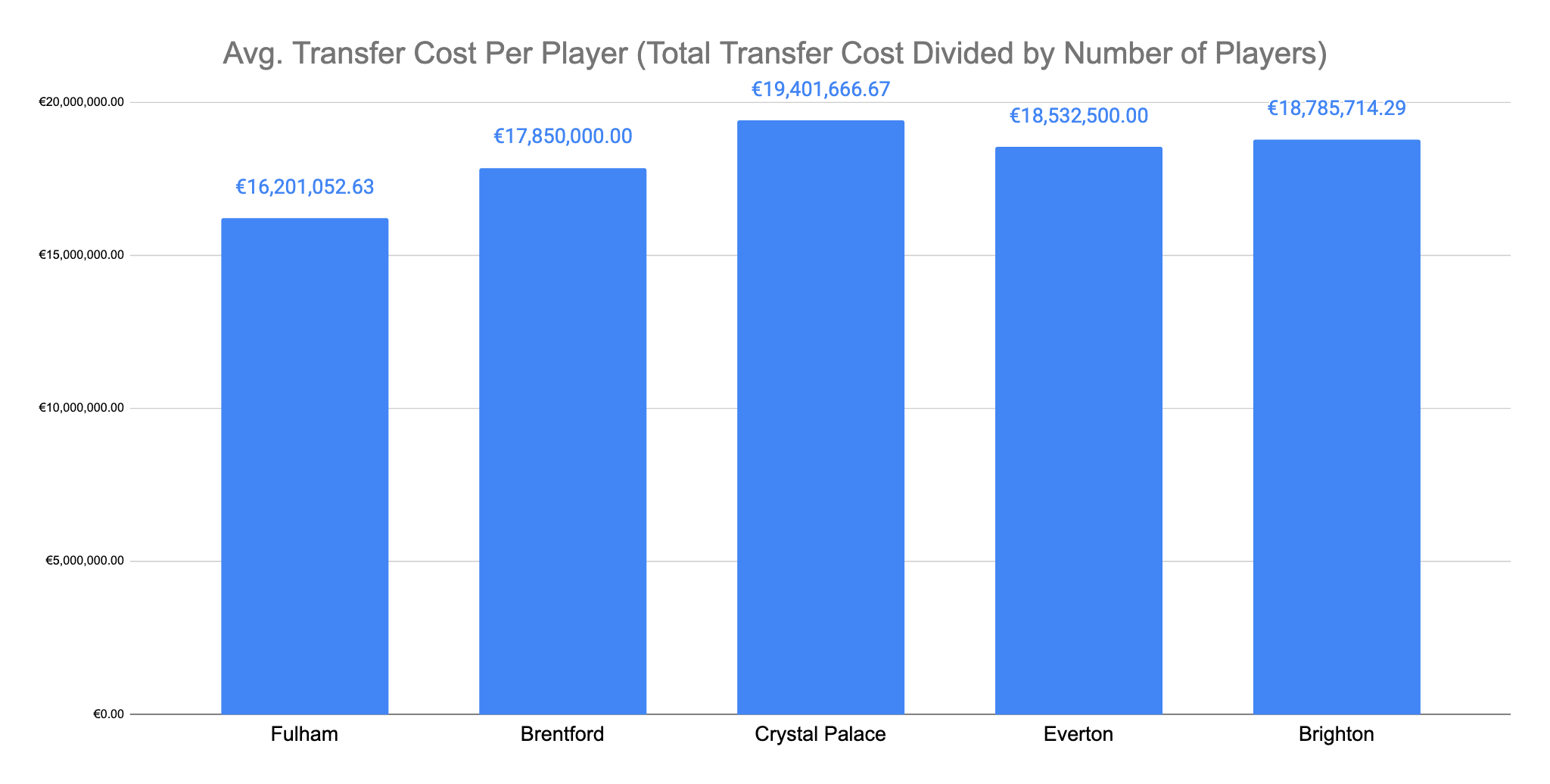
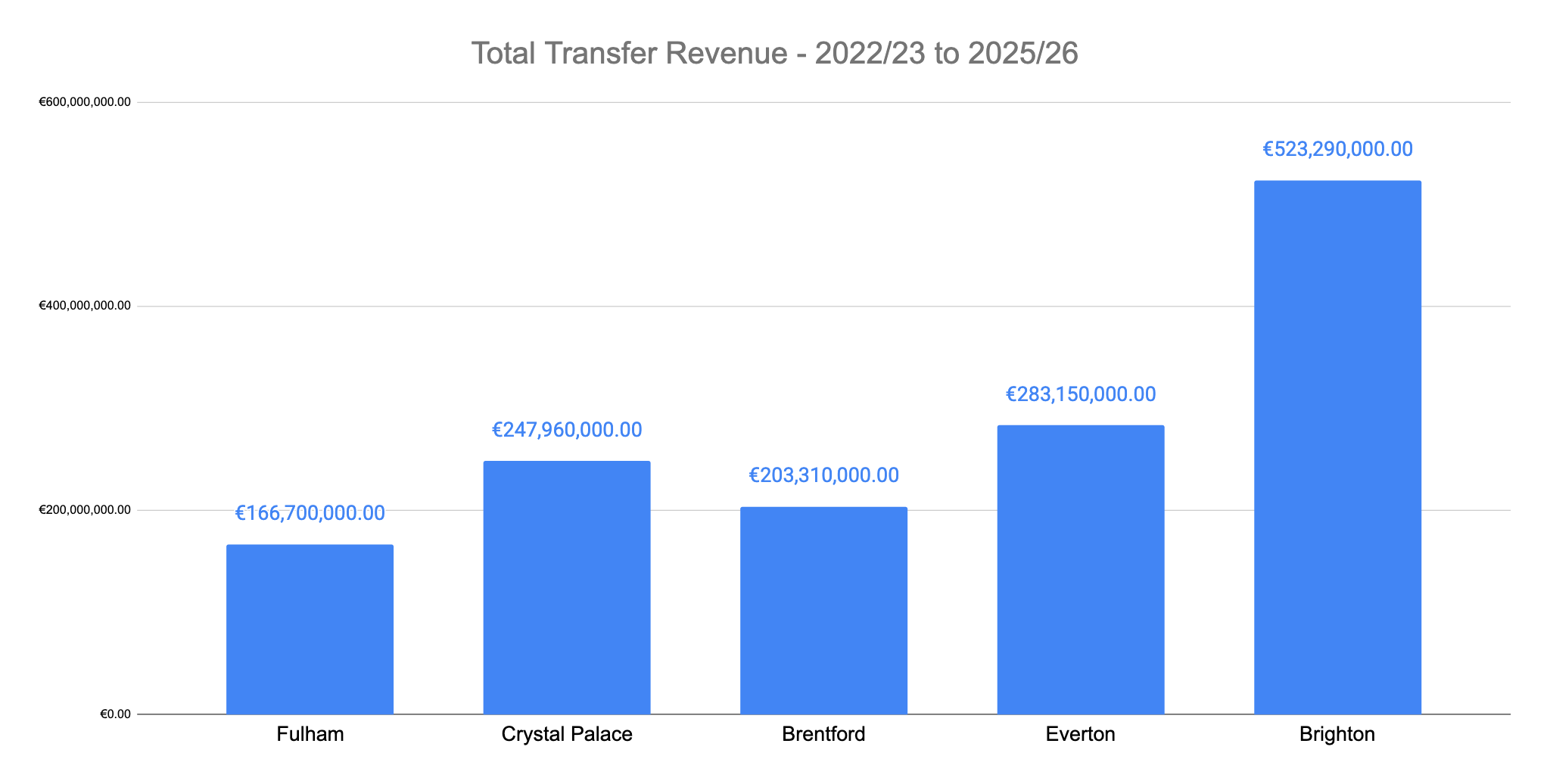
And, while Fulham has been, on average, able to spend less for its players than other teams.
It has received substantially less for the players it sold for the seasons from 2022-23 to 25-26. Tens of millions of Euros less.
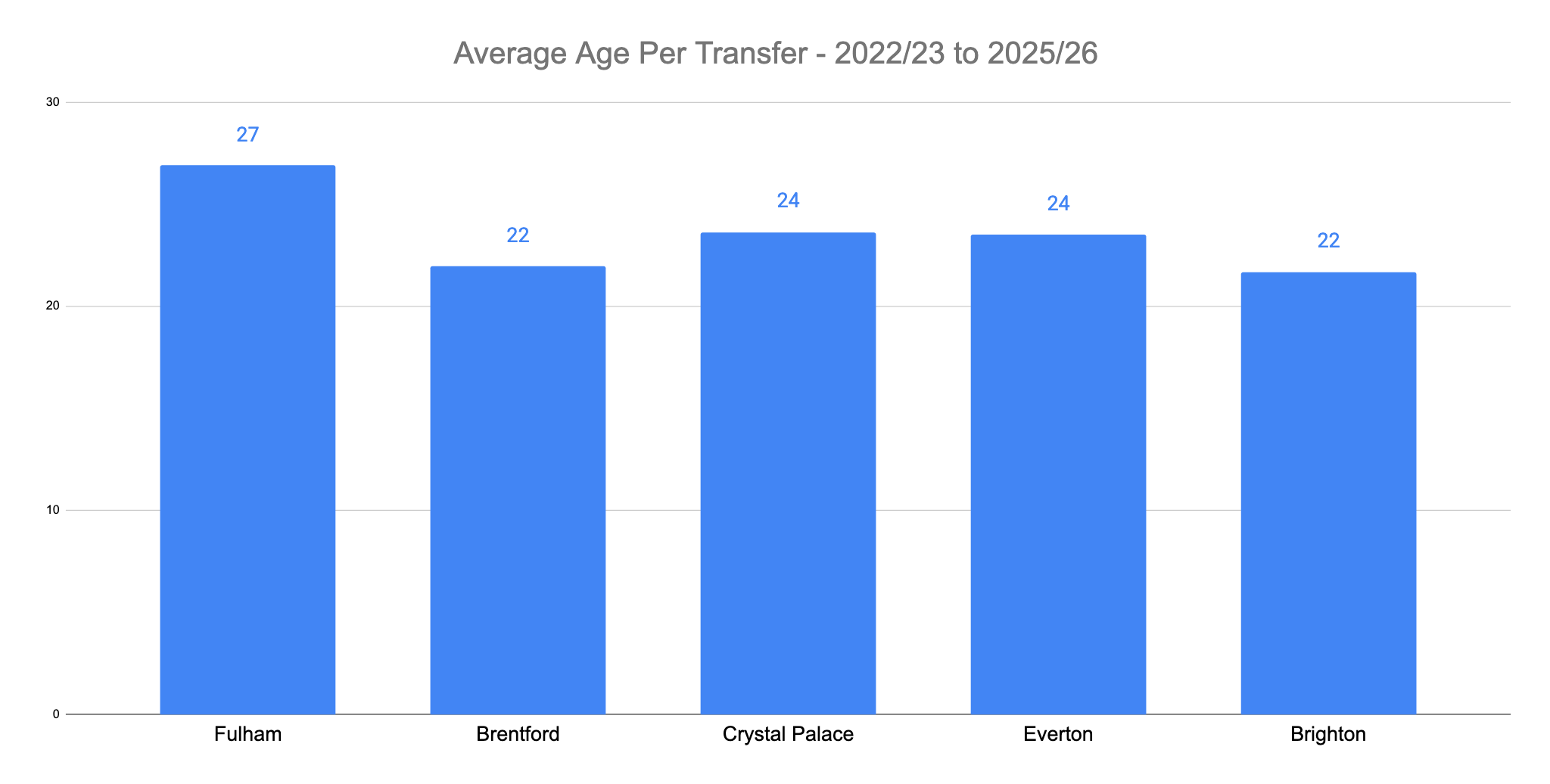
The reason why is pretty clear when you look at the age of the players Fulham has bought. The average age of players we bought was substantially older and, while these players, under Marco, got us good results in terms of final standing on the league table, it is harder to sell and get large fees for sales of generally older Fulham players, as witnessed by the recent Issa Diop transaction.
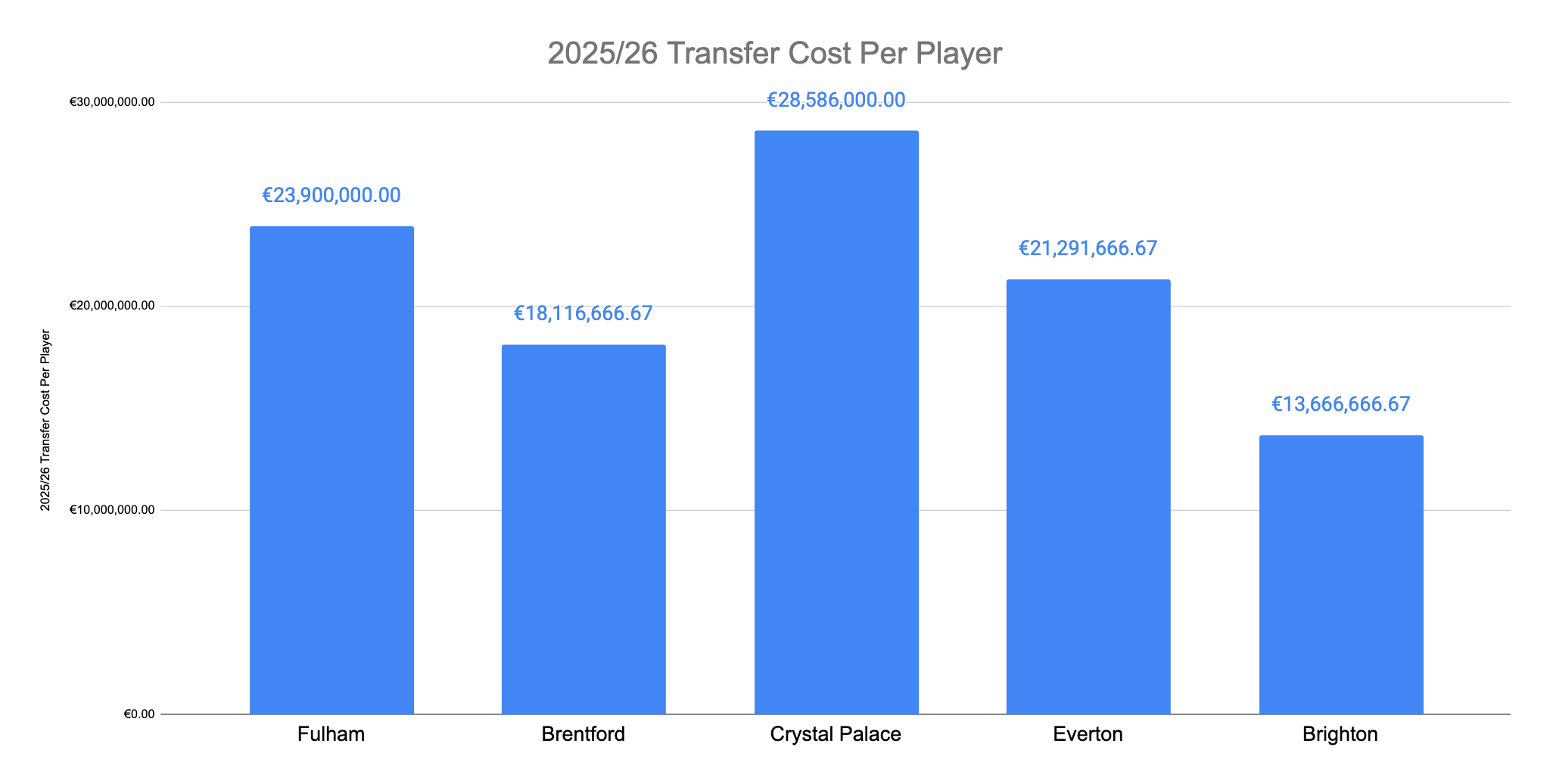
Fulham did go younger last year; Oscar Bobb and Kevin were both only 22 when we bought them but we also, despite waiting until just 13 days before the deadline, spent more on our transfers, per player, in 2025-26 than any other team in the group analyzed except for Crystal Palace.
We also bought about half as many players as other teams in this group in 2025-26 - just three compared to six for every other time (except for Crystal Palace, which bought five).
Now, I am a fan of Kevin and Oscar Bobb and believe and hope that they will be real contributors to the team and players we can sell for profit if need be but I do worry that we weren’t able to buy the other players that we need to compete like a midfielder to replace Andres Pereira
And, I believe that the “wait until the last minute” strategy is not helping us. This is because waiting, according to my analysis, is not necessarily correlated with getting the best deal. And, we seem to be getting fewer players and spending more - relative to Transfermkt values - than in the past and (in some cases) compared to other teams in the sample.
Yes, I am sure that - on one or two occasions - waiting might have helped get a better deal. But, just like my New York friend hoping that the arrival of the uptown subway train means her downtown train will soon arrive because it had happened once or twice before, it is not necessarily a likely predication of future events.
But, always waiting until the last minute does means that we are 100% guaranteed to lose potential deals and opportunities because we are unwilling to do what is necessary to lock up players earlier (when they are available).
It’s also clear from the data that other teams know about and have tried the “wait until the last minute” strategy but have since moved on. It makes sense. Matthew Benham, the owner of Brentford, and Tony Bloom, the owner of Brighton, are former options and derivatives traders whose current business (and team management) is entirely predicated on optimizing and getting the maximum return for the bets they make (on investments, gambling and players). They, and Brentford and Brighton, would also always wait until the last minute if it gave them an advantage but instead they are focused on closing the deal, as soon as they can, for the player they think will give the most value because they understand, unlike Fulham, that they are not the only bidders in the market. They understand that they are competing for players with other clubs.
And, presumably, the teams that sell players have figured out that giving up value at the end of a window is not worth it and are more than willing to - as we have seen in past transfer markets (think of the Andre negotiations) - to walk away and wait for the next one. What matters now is finding a way to sign players to help you win and that you can later sell to get the revenue needed to keep winning. This will become more important under the SCR rules which make it essential for mid table teams like Fulham to be able to buy and sell younger players.
And, the market has gotten more, not less, competitive for the younger players we need and want to sign. As a recent article in the Athletic noted:
“Young players are what everyone wants, so it has led to a distorted market,” says one recruitment figure. Consequently, what used to be a more straightforward process of signing youth can prove protracted.”
Many Premier League teams are becoming more and more sophisticated and are using models to maximize value while Fulham appears to be held hostage to a questionable and simplistic view that it can only get the best deal by waiting and effectively reducing the time we have to identify, find, negotiate and finalize deals in an increasingly complicated and difficult market.
I hope news that deals for Garcia and Palacios are close (one month prior to close!) and what Tony said in his interview with Jack Kelly indicates an awareness that it might be time to move on from this unsophisticated approach and its likely champion.
We will see!
Nice work, Matt. I think as Marcin alludes to below, the short-sighted nature of the approach is worrying, compared to a, getting your actual targets (Andre and Dewsbury Hall as examples of we didn't), b, getting a balanced deal which as your analysis shows is not really evident as the only reason you get a 'deal' last minute is if a club is desperate to sell and that tells its own story, but also c, now Fulham have been doing this for such a long time all the agents and clubs know what we are trying to do.
The sums also do not add up. I did a simple analysis of 4 players, at varying wages from 40k to 100k a week, signed on Jun 15, July 15 and August 15 and the savings versus signing on September 1st:
Weekly Wage Jun 15. July 15. Aug 15
Player A £50,000 £555,616 £341,918 £121,096
Player B £40,000 £444,493 £273,534 £96,877
Player C £75,000 £833,425 £512,877 £181,644
Player D £100,000. £1,111,233 £683,836 £242,192
Total Wages £2,944,767 £1,812,164 £641,808
So if we signed all 4 on June 15th the total savings is indeed "millions" and that's 1-2 places in the table. I am ignoring interest costs on transfer fees and agents fees. The 25-26 season each place was worth 3-4 million (it's complicated as it's not a fixed amount but other than Forest each team received 3-4 million more than the team one place below) so by signing everyone we need by July 15 is paid off by one place in the table. So TK has been sold a pup by someone and I agree with you that the most likely person doing this is Ali Mac, to justify his inflated salary.
We have already spent so much time trying to sign 2 young players from Real Madrid and we still haven’t actually signed them,we also need other signings for different positions so I hope we are doing something to address this before the transfer window closes.